The Challenge of Scale in Maritime Operations
Organizing a maritime event for 30 to 100+ guests is a complex logistical operation that requires a departure from standard charter thinking. While a typical yacht accommodates 8–12 passengers, a large-scale event—whether a corporate retreat, wedding, or milestone celebration—demands specialized vessels with high-capacity stability and professional event infrastructure. The primary objective is to maintain a premium, intimate atmosphere while managing the high-volume requirements of catering, safety, and movement. Success in this category depends on meticulous pre-voyage planning and the selection of a vessel specifically engineered for high-occupancy service.
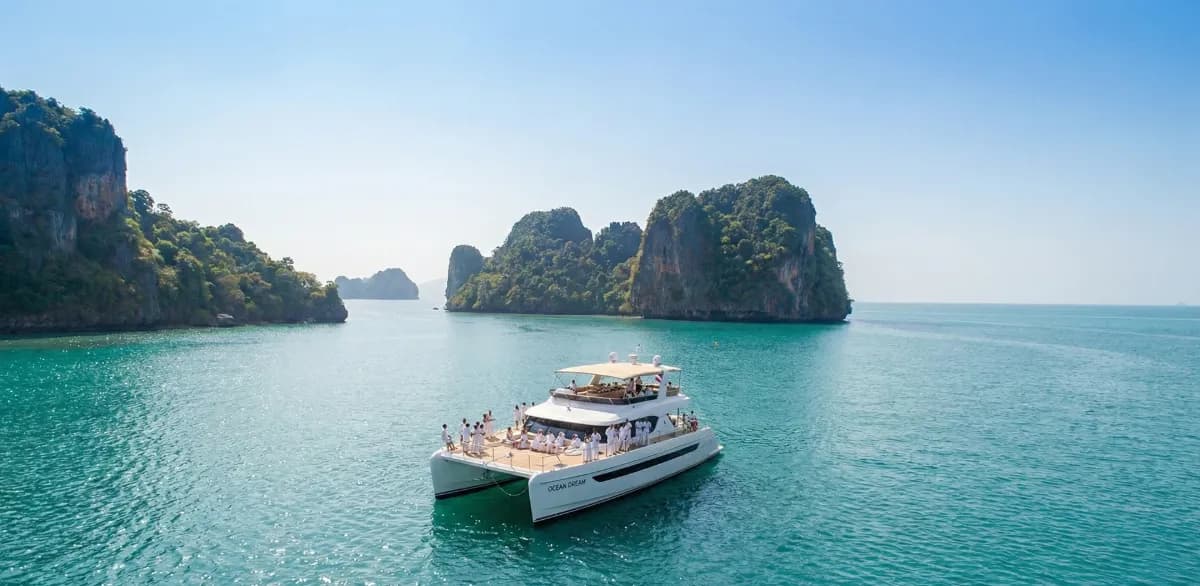
In the Thai maritime sector, only a limited fleet of "Event Catamarans" and "luxury cruise tenders" are licensed to carry over 30 passengers. These vessels feature expansive open decks, heavy-duty stability systems, and professional-grade industrial galleys. Choosing the right platform is the first step in ensuring that the event feels like a curated experience rather than a crowded transport.
Technical and Operational Prerequisites
Managing a large group at sea introduces technical variables that do not exist on smaller charters. The "complexity of movement" increases exponentially with every guest, requiring a highly disciplined crew and a vessel with sufficient square footage per person.
Vessel Stability and Beam: For groups of 30+, a large power catamaran is the professional standard. Its wide beam (width) provides two distinct hulls for stability, minimizing the risk of seasickness for less experienced guests and allowing for a "walk-around" environment.
Safety Ratios and Life Saving Appliances (LSA): Marine regulations mandate a specific crew-to-guest ratio for high-capacity vessels. Furthermore, the boat must be equipped with SOLAS-grade life rafts and jackets for the exact number of passengers on board.
Embarkation Logistics: Loading 50+ guests from a beach or a small tender is time-consuming and inefficient. Professional large-group charters prioritize "Stern-to-Pier" or "Side-on" boarding at deepwater marinas (like Ao Po or Royal Phuket Marina) to ensure a safe, dry, and rapid boarding process.
Metric | Standard Yacht (10 guests) | Event Catamaran (50 guests) |
Deck Area | ~60 - 80 sqm | 200 - 400+ sqm |
Crew Complement | 2 - 3 (Captain + Host) | 8 - 12 (Service, Chef, Safety) |
Boarding Method | Flexible / Tender | Marina Pier Only |
Catering Style | Plated / Family Style | Buffet / Passing Canapés |
Strategic Catering and Service Flow
Feeding 30+ people in a moving marine environment requires industrial-level coordination. A professional large-group charter replaces individual plating with a "Flow-Based" service model.
Buffer and Action Stations: To prevent bottlenecks, food should be distributed across multiple stations (e.g., a central buffet, a seafood grill at the stern, and a pass-around canapé service).
High-Volume Hydration: Large groups consume significant quantities of water and ice. Professional vessels utilize integrated high-capacity ice makers and filtered water systems to eliminate the logistical burden of thousands of plastic bottles.
Service Staffing: For groups over 30, a dedicated Cruise Director is essential. This individual manages the flow of the event, coordinates with the galley, and acts as the primary point of contact for the host, allowing the captain to focus entirely on navigation.
Planning the Itinerary for Large Groups
The tactical goal of a large group itinerary is to minimize "dead time" and maximize "active time." Because high-capacity vessels are larger and slower than speedboats, destination selection is critical.